
Can Music Help Clients Recover from Acute Stress?


A patient arrives shaken after a hard conversation or a frightening result, and you have a quiet quarter hour before the next step. Reaching for music feels natural, and a new imaging study supports that instinct as a short-lived response to acute stress (You et al., 2026).
The study found advantages over water sounds on some recovery measures in carefully selected healthy young adults. The effects are modest, and the wider literature is mixed. What follows lays out what the study found and how to turn it into a brief listening trial that centers the patient's own report.

A new study makes a modest case for music after stress
You et al. (2026) recruited 120 healthy young adults for two experiments and randomly assigned 60 participants in each to relaxing music or water sounds. Everyone first completed timed arithmetic under performance pressure, and the researchers then tracked recovery. Water sounds served as an active control, a comparison condition that supplies an alternative intervention rather than nothing at all. That choice makes the comparison more demanding than music versus silence. It still cannot tell you which feature of the music did the work.
The music group showed medium-sized advantages in positive mood and heart rate recovery at the final comparison. A separate analysis of late recovery found a steeper decline in electrodermal activity (EDA), a measure of how readily the skin conducts a small electrical current. Those effects justify offering music after a stressful event. They do not justify assuming that any individual patient will feel relief, so check.
The imaging experiment's recovery analyses included 58 participants and found lower salivary cortisol, a stress hormone, in the music group (You et al., 2026). The authors themselves flagged a preintervention cortisol imbalance between groups and variability in the laboratory assay.
An early mood advantage remained uncertain because that analysis did not correct for the many comparisons performed. Read the cortisol result as encouraging and the early mood result as unproven.
Music played before the stressor did not significantly blunt the initial response, though sparse cortisol sampling limited that test. Group mean ages ranged from 22 to 23 years. Screening excluded elevated anxiety or depression scores and anyone who reported little reward from music.
The study measured recovery over minutes and did not establish lasting benefit or treatment effects in clinical disorders. Tell patients that music may speed recovery, and avoid promising that it will prevent the next stress response.
The scans point to a hypothetical pathway
The second experiment used functional magnetic resonance imaging (fMRI), which tracks blood-oxygen changes linked to brain activity (You et al., 2026). The researchers focused on musical tension, the pull of anticipation or uncertainty that builds and resolves as a piece unfolds. Ratings of that tension tracked shifting interactions among regions involved in hearing and stress regulation.
That network included the auditory cortex, which processes sound, and the insula, which integrates internal bodily sensations with their emotional meaning (You et al., 2026). It also included the thalamus, a deep structure that relays and coordinates information across brain networks.
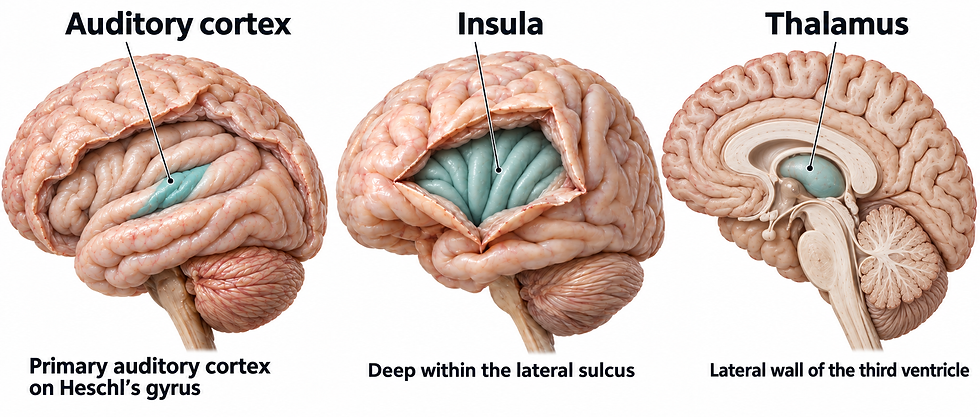
The authors propose that changing interactions among these regions could help explain recovery during listening. For a clinician, that proposal is an interesting account of why a patient might settle, and nothing more yet.
The analysis relied on dynamic causal modeling (DCM), which estimates how brain regions influence one another within a specified mathematical model (Friston et al., 2003). Its conclusions inherit that model's assumptions. Here, the model restricted some reverse-direction effects, and participants rated musical tension on a later day rather than during scanning (You et al., 2026).
The scans support a plausible mechanism. They do not show that musical tension and its resolution caused recovery, because the researchers never manipulated tension while holding other musical features constant (You et al., 2026).
Choose music by how the patient responds to it, and resist any urge to tell someone that a particular composition will reset a brain circuit.
Benefits depend on who is listening and where
The wider literature keeps expectations in check. A meta-analysis that statistically pools results across studies found a small, statistically nonsignificant average benefit across 14 experiments with 706 healthy participants (Adiasto et al., 2022).
The uncertainty interval included no benefit, and results varied substantially between studies (Adiasto et al., 2022). A later experiment assigned 105 healthy women to researcher-selected music, self-selected music, water sounds, or silence after stress (Song et al., 2024). Music showed no clear overall recovery advantage across subjective and biological stress measures (Song et al., 2024).
Clinical settings offer stronger encouragement. A 2026 review of 33 surgical trials reported a medium reduction in anxiety in its main analysis (Yu et al., 2026). That analysis kept 25 studies after excluding eight with extreme results, which limits confidence in how widely the estimate applies. The review supports offering music around surgery while leaving the expected benefit for any particular patient open.
Intensive care tells a more cautious story. Patient-directed music reduced anxiety more than usual care in 373 patients receiving mechanical ventilation, though it did not outperform noise-canceling headphones (Chlan et al., 2013). Investigators registered that trial after recruitment began (University of Minnesota, 2013).
A 2025 trial of 158 older ventilated adults found no significant anxiety or pain benefit over a silent recording delivered through identical equipment (Khan et al., 2025). Do not assume that slow music reliably relieves distress in the ICU.
Feeling better and recovering physiologically can part ways. A 2025 pilot of 20 Turkish immigrant women who perceived chronic ethnic discrimination found lower reported stress after music without improvement in the measured biological stress markers (Hirsch et al., 2025). In an earlier experiment, music improved mood while delaying recovery of systolic blood pressure, the arterial pressure during the heart's contraction (Radstaak et al., 2014). Ask about relief directly, and interpret physiological changes on their own terms.
Measure comfort without overreading the sensor
You et al. (2026) measured pulse timing with photoplethysmography (PPG), an optical method that detects blood-volume changes near the skin. Pulse rate variability (PRV) describes variation between successive detected pulses, whereas heart rate variability (HRV) describes variation between successive heartbeats (Schäfer & Vagedes, 2013). The two can disagree during stress, as Schäfer and Vagedes (2013) note.
The low-frequency/high-frequency (LF/HF) ratio compares the strength of slower and faster fluctuations in interval timing (Billman, 2013). You et al. (2026) read changes in this ratio as a healthier balance of the nerve activity controlling the heart. That reading exceeds what the ratio can measure because it does not index the balance between sympathetic and vagal signals regulating the heart, as Billman (2013) reviews. This is the one place where the paper's interpretation needs correcting before you repeat it to a colleague.
Use the patient's reported relief as the main outcome of a brief listening trial. If physiological monitoring is clinically indicated, interpret it separately and keep the recording method the same from session to session. Never let a wearable's shifting score override a patient's report that the music feels wrong.
Run a brief listening trial with a clear follow-up
Once immediate care needs allow a quiet interval, ask whether the patient would like music, and make quiet an equally welcome answer. Invite them to pick a familiar piece they associate with comfort. Ask about unwelcome memories or sound sensitivity before pressing play. Keep the volume comfortable and ensure the patient can hear staff.
Fifteen minutes is a reasonable starting length. You et al. (2026) used 15 minutes of audio during imaging and 21 minutes in the behavioral protocol, and they did not compare durations. Treat 15 minutes as a practical starting point, not an established dose. Explain that choosing familiar music is a preference-based clinical decision, because the new experiment used researcher-selected pieces.
Before listening, ask the patient to rate distress from 0 to 10, with 0 meaning none and 10 meaning extreme. Repeat the same question afterward and ask whether the change felt worthwhile. This informal check guides the next session; it is neither a diagnostic test nor a validated treatment threshold.
Record the chosen music and listening length alongside both distress ratings. Stop or change the music if discomfort rises or unwanted memories surface. If the patient asks to stop, end the trial without discussion. On another suitable occasion, compare the experience with a quiet break of similar length. Keep whichever option the patient prefers and finds consistently helpful.
For recurring distress or complex needs, consider referring the patient to a credentialed music therapist. Music therapy delivers individually planned music interventions within a therapeutic relationship, provided by a trained and credentialed professional (American Music Therapy Association, n.d.). A listening trial is a comfort measure, so keep assessing and treating when distress persists or interferes with care.
Make music one option in an individualized recovery plan
The strongest clinical signal in this literature is the reduction in surgical anxiety, and the weakest is any claim about brain circuits. Between those poles sits a cheap, low-risk comfort measure that some patients value and others do not.
The evidence supports a monitored trial of music when the patient welcomes it, with benefits that vary by setting and by outcome (You et al., 2026). The brain-network findings offer a possible explanation, and the clinical decision still rests on whether listening gives worthwhile relief. Agree on the symptoms you will track and review the response before making music a routine part of care.
Five key takeaways
1. Offer music as an optional aid to recovery after acute stress. Do not promise that it will prevent the next stress response.
2. Expect individual differences. Mood can improve while physiological measures stay flat or lag behind.
3. Treat the proposed brain mechanism as a hypothesis. The study did not show that musical tension itself caused recovery.
4. A change in the LF/HF ratio does not mean that there is a healthy autonomic balance.
5. Run a brief listening trial with distress rated before and after, and adjust the plan to the patient's experience.

Glossary
active control: a comparison condition that supplies another intervention, such as water sounds, to help evaluate an intervention's specific effects.
acute stress: a short-lived response to an immediate challenge.
auditory cortex: brain cortex involved in processing sound.
cortisol: a hormone involved in the stress response, which researchers can measure in saliva.
dynamic causal modeling (DCM): a mathematical approach that estimates directed influences between brain regions within a specified model; interpretation depends on its assumptions.
electrodermal activity (EDA): variation in how readily the skin conducts a small electrical current.
functional magnetic resonance imaging (fMRI): an imaging method that tracks blood-oxygen changes linked to brain activity.
heart rate variability (HRV): variation in the time intervals between successive heartbeats.
insula: a brain region that integrates internal bodily sensations with their emotional meaning.
low-frequency/high-frequency (LF/HF) ratio: a comparison of the strength of slower and faster fluctuations in interval timing; it does not reliably measure the balance of nerve activity regulating the heart.
meta-analysis: a statistical method that pools results from multiple studies.
music therapy: individually planned music interventions delivered within a therapeutic relationship by a trained, credentialed professional.
musical tension: the pull of anticipation or uncertainty that builds and resolves as music unfolds.
photoplethysmography (PPG): an optical method for detecting blood-volume changes near the skin.
pulse rate variability (PRV): variation in the time intervals between successive detected peripheral pulses.
systolic blood pressure: arterial pressure during the heart's contraction.
thalamus: a deep brain structure that relays and coordinates information across brain networks.
References
Adiasto, K., Beckers, D. G. J., van Hooff, M. L. M., Roelofs, K., & Geurts, S. A. E. (2022). Music listening and stress recovery in healthy individuals: A systematic review with meta-analysis of experimental studies. PLOS ONE, 17(6), Article e0270031. https://doi.org/10.1371/journal.pone.0270031
American Music Therapy Association. (n.d.). What is music therapy? https://www.musictherapy.org/about/musictherapy/
Billman, G. E. (2013). The LF/HF ratio does not accurately measure cardiac sympatho-vagal balance. Frontiers in Physiology, 4, Article 26. https://doi.org/10.3389/fphys.2013.00026
Chlan, L. L., Weinert, C. R., Heiderscheit, A., Tracy, M. F., Skaar, D. J., Guttormson, J. L., & Savik, K. (2013). Effects of patient-directed music intervention on anxiety and sedative exposure in critically ill patients receiving mechanical ventilatory support: A randomized clinical trial. JAMA, 309(22), 2335–2344. https://doi.org/10.1001/jama.2013.5670
Friston, K. J., Harrison, L., & Penny, W. (2003). Dynamic causal modelling. NeuroImage, 19(4), 1273–1302. https://doi.org/10.1016/S1053-8119(03)00202-7
Hirsch, S., Feneberg, A. C., Skoluda, N., Nater, U. M., & Mewes, R. (2025). Pilot study of an ecological momentary music intervention for stress reduction in Turkish immigrant women perceiving chronic ethnic discrimination. Scientific Reports, 15(1), Article 12274. https://doi.org/10.1038/s41598-025-96998-1
Khan, B. A., Khan, S. H., Perkins, A. J., Heiderscheit, A., Unverzagt, F. W., Wang, S., Downs, J. H., III, Gao, S., & Chlan, L. L. (2025). Slow-tempo music and delirium/coma-free days among older adults undergoing mechanical ventilation: A randomized clinical trial. JAMA Internal Medicine, 185(12), 1442–1453. https://doi.org/10.1001/jamainternmed.2025.5263
Radstaak, M., Geurts, S. A. E., Brosschot, J. F., & Kompier, M. A. J. (2014). Music and psychophysiological recovery from stress. Psychosomatic Medicine, 76(7), 529–537. https://doi.org/10.1097/PSY.0000000000000094
Schäfer, A., & Vagedes, J. (2013). How accurate is pulse rate variability as an estimate of heart rate variability? A review on studies comparing photoplethysmographic technology with an electrocardiogram. International Journal of Cardiology, 166(1), 15–29. https://doi.org/10.1016/j.ijcard.2012.03.119
Song, Y., Ali, N., & Nater, U. M. (2024). The effect of music on stress recovery. Psychoneuroendocrinology, 168, Article 107137. https://doi.org/10.1016/j.psyneuen.2024.107137
University of Minnesota. (2013). Anxiety self-management for ICU patients receiving mechanical ventilation [Clinical trial record; NCT00440700]. ClinicalTrials.gov. https://clinicaltrials.gov/study/NCT00440700
You, S., Zhang, L., Wu, G., & Du, Y. (2026). The structural dynamics of music drive acute stress recovery through functional reorganization of stress-regulation networks. Proceedings of the National Academy of Sciences, 123(37), Article e2611584123. https://doi.org/10.1073/pnas.2611584123
Yu, Y., Sabran, K., Wang, G., & Chen, Z. (2026). Effect of music intervention on anxiety in surgical patients: Systematic review and meta-analysis of randomized controlled trials. General Hospital Psychiatry, 99, 50–65. https://doi.org/10.1016/j.genhosppsych.2026.01.008


Comments