
Attention Can Reduce Inflammation: What This Means for Your Practice


Clinicians often ask their clients to scan for bodily sensations. A new set of experiments suggests that attention may change physical responses, not just our subjective experiences. The researchers found that attending to an itch made it feel stronger while the visible skin reaction became smaller.
Paying attention changed the skin response
The researchers studied inflammation, the body's protective response to injury or other challenges, using a brief skin reaction in healthy adults. They applied histamine, a chemical messenger that produces itching, swelling, and redness, through a small skin prick. They measured the wheal (the raised swelling) and the flare (the surrounding redness) six times over 20 minutes.
Participants completed separate sessions that directed attention toward sensations at the test site or toward a distracting task. Each person therefore served as their own comparison, and the researchers counterbalanced the order of conditions. The experimenter measuring the skin reactions did not know which attention condition the participant was performing.
The first experiment included 37 people and used videos for distraction. The second included 20 different people and showed the same abstract shapes in both conditions. Participants either evaluated the shapes or used each shape change as a reminder to notice sensations at the test site. This comparison addressed whether the visual material or task demands explained the result.
Directing attention toward the affected skin produced smaller reactions than directing attention away from it. The finding appeared in two independent groups within the same research program. Participants needed no meditation course and no feedback device, only a spoken instruction.
The authors describe this bodily focus as interoceptive attention, attention directed toward sensations arising from the body. Participants kept looking at the screen; they did not need to inspect the irritated skin. The instruction resembles the body-focused attention that biofeedback providers already coach, with one difference. Providers add a display of a physiological signal, and this study did not.
The swelling difference was large within this experiment
At 20 minutes in the first experiment, mean wheal diameter was 3.5 mm during bodily attention and 5.0 mm during distraction. That is a 1.5 mm difference, or 30% smaller relative to the distraction condition, calculated from the reported means. The authors reported a large effect size, a measure of the magnitude of a difference: Cohen's d was 1.30. Redness also decreased, with a small-to-medium standardized effect, d = 0.42.
Approximately 90% of participants showed smaller swelling during bodily attention. In the first experiment, swelling had stabilized or decreased by 20 minutes in about 89% during attention, compared with 46% during distraction.
These recovery classifications were exploratory, meaning the researchers had not specified them before examining the data. They describe early changes during a short observation period. Complete healing and lasting disease improvement lie outside what a 20-minute recording can show.
The results support a measurable effect on an experimentally induced skin reaction. They do not establish that focused attention reduces inflammation throughout the body or benefits patients with chronic inflammatory disease. A large laboratory effect can still have uncertain clinical value.
The study also included no neutral condition in which no one guided attention. Consequently, the comparison cannot determine whether bodily attention reduced the usual reaction, distraction enlarged it, or both contributed. This distinction matters before you tell a client that distraction worsens inflammation.
Stronger sensations did not mean a larger reaction
In the second experiment, participants rated itching and burning as stronger during bodily attention, a medium-sized difference, even though their skin reactions were smaller. Sensation and visible inflammation therefore moved in opposite directions. The finding cautions against treating symptom intensity as a direct measure of inflammatory activity in this setting.
To explore whether sensory input mattered, 17 returning participants completed another experiment using lidocaine, a medicine that numbs the skin. With sensation reduced, bodily attention retained some effect on swelling, but the effect was weaker than with intact sensation.
Wheal size under lidocaine sat between the two original conditions, and the faster late decline seen with intact sensation disappeared. These were returning volunteers, so the third experiment did not add another independent group of 17 people.
Signals from the affected tissue may help the nervous system regulate the local response. However, the lidocaine experiment only partly identifies how attention works. Numbing was incomplete, and the researchers did not directly measure the immune cells or chemical signals responsible for the smaller reaction.
This section carries the most immediate lesson for interoceptive training. Clients who learn to attend to breath or muscle sensations often report that sensations feel more intense at first. In this experiment, stronger sensation accompanied a smaller physical reaction. You can tell a client that noticing a sensation more clearly does not, by itself, mean the tissue is doing worse.
The same dissociation works in reverse for your outcome measures. Feeling better did not establish that inflammation had fallen, and feeling worse did not establish that it had risen. Symptom ratings remain the right primary outcome for most biofeedback plans because symptoms are what clients came to change. Treat them as a report of experience and not as a proxy for tissue state.
The HRV finding hints at vagus nerve involvement
The researchers found higher heart rate variability (HRV), variation in the intervals between successive heartbeats, during bodily attention. The difference was small, with d = 0.34. They interpreted this as consistent with vagus nerve involvement, a major pathway carrying signals between the brainstem and internal organs. However, they did not record or experimentally block vagal activity.
Higher HRV accompanied the smaller skin response, but it did not establish that vagal activity caused that response. HRV describes cardiac timing and can reflect autonomic modulation, changes in how involuntary neural regulation influences an organ. It does not directly measure the brain's control over immune cells.
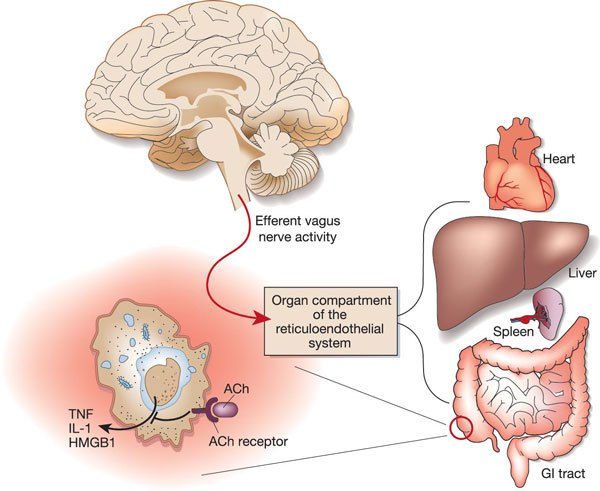
Resonance frequency breathing may share a mechanism with vagus nerve stimulation (VNS). Both appear to engage the parasympathetic cholinergic system that regulates immune function through interleukins and interferons (Gevirtz, 2013; Tracey, 2007). The link between vagal tone and immunity is among the most promising frontiers in HRV biofeedback research.
The pathway runs in both directions. Sensory vagal afferents detect inflammation and infection by responding to tumor necrosis factor (TNF) and interleukin-1 (IL-1). Vagal motor efferents then relay signals through descending neurons that release norepinephrine onto splenic T cells. These T cells respond by releasing acetylcholine, which acts on macrophages to suppress inflammatory cytokine production (Schwartz, 2015). This circuit, the cholinergic anti-inflammatory pathway, gives vagal tone a direct line to inflammatory control.
The measurement details matter for anyone who records HRV professionally. The HRV measure was the coefficient of variation of the RR interval, the time between successive heartbeats: its standard deviation divided by its mean across the 20-minute period. The authors computed it from the electrocardiogram (ECG), the electrical recording of the heartbeat, and restricted analysis to intervals between 600 and 1,200 ms. They also recorded a finger pulse signal. Variability taken from such an optical sensor is pulse rate variability, timing variation between pulse waves.
The authors never ran three preregistered secondary analyses. They were the RMSSD, the root mean square of successive differences between RR intervals, and the SDNN, the standard deviation of those intervals. They also omitted the planned analysis of the LF/HF ratio, the ratio of low-frequency power to high-frequency power.
Readers therefore cannot compare these results with the time-domain or frequency-domain values that clinical software reports.
Keep three quantities separate when you read this study, as house practice requires for any HRV claim. The 20-minute value is task-phase HRV recorded during an attention task. It is not resting HRV, and it is not a clinical outcome. The authors acknowledged that HRV provides only an indirect index of vagal activity, and the experiment did not test HRV biofeedback.
The other channels tell a biofeedback provider something useful. Skin conductance, the electrical conductance of the skin that rises with sweat gland activity, did not differ between conditions. Neither did heart rate, skin temperature at the inner elbow, or reported anxiety.
Breathing and mindfulness trials show why the outcome you pick matters
Separate experiments make communication between the brain and immune system biologically credible. In mice, Jin et al. (2024) identified a circuit linking vagal sensory signals with brainstem control of inflammation. Manipulating that circuit changed cytokines, proteins that help cells coordinate immune responses. This animal research supports a possible mechanism; it does not establish which circuit human attention recruited.
One human experiment often cited in the biofeedback community points in a different direction. In a small randomized experiment, 24 healthy men received an intravenous bacterial-component challenge after half of them had trained for 10 days in breathing techniques, cold exposure, and meditation.
The trained group showed lower levels of several inflammatory cytokines, along with increased adrenaline, a hormone associated with bodily activation (Kox et al., 2014). The breathing involved cyclic hyperventilation and breath holds, the opposite of the slow, paced breathing that HRV biofeedback teaches. A client who cites that study as evidence for slow breathing has the wrong study.
Mindfulness, attention to present experience held with an accepting attitude, adds a component this study did not test.
Rosenkranz et al. (2013) compared eight weeks of mindfulness training with an active comparison program offering other health-promoting activities. After a laboratory stressor, the mindfulness group showed a smaller skin inflammatory response induced by capsaicin, the irritating compound in chili peppers.
Both groups improved similarly in reported distress and physical symptoms. The result again separated changes in experience from changes in a physical response.
A small trial of 35 stressed, unemployed adults compared a three-day mindfulness retreat with a relaxation retreat. The mindfulness group showed a relative improvement in interleukin-6 (IL-6) at four months, a cytokine measured in blood as an indicator of inflammation (Creswell et al., 2016).
In contrast, Villalba et al. (2019) found no overall reduction in C-reactive protein (CRP), a blood protein used to assess inflammation, across two mindfulness trials. Benefits suggested in selected subgroups were exploratory.
The distinction persisted in a larger trial involving 190 lonely adults aged 65 to 85. Eight weeks of mindfulness produced a small reduction in NF-κB activity, a protein that switches on inflammatory genes, compared with a matched health education program (d = 0.17). It did not reduce circulating IL-6 or CRP relative to that program (Lindsay et al., 2024). Changes inside immune cells and changes in blood protein concentrations are different outcomes.
Attention-based practices can affect selected physiological outcomes under some conditions. The evidence does not justify promising a general reduction in inflammation. Name the outcome that improved in each study you cite. A skin measurement, a gene-expression result, a cytokine level, or an HRV change cannot substitute for demonstrated clinical benefit (Lindsay et al., 2024; Mizrachi et al., 2026).
What providers can do now
Start with what you say. When a client asks about the study, describe it as a 20-minute skin reaction in healthy young adults in which attending to the site produced a smaller reaction than distraction. Add that the trial did not test biofeedback, chronic disease, infection, or older adults. That description is accurate and still interesting, and it keeps you out of claims the authors themselves declined to make.
Next, look at your own instructions. Many providers teach distraction for pain or itch. The paper's authors note that this habit may carry a physiological cost in some contexts, although they flag that possibility as untested. Nothing here justifies removing distraction from a client's toolkit. It does justify offering interoceptive attention as an alternative skill and letting the client compare them.
That comparison can become a structured within-client check, which is the design the study itself used. Alternate sessions or days in which the client practices distraction versus attending to the sensation during a recurring symptom, and record symptom ratings and any physiological measures you already collect. Vary the order so time and habituation do not favor one condition. This is practice-based evaluation for one client, and it produces no evidence about anyone else.
Interoceptive attention fits naturally inside an HRV biofeedback session, where clients already attend to breath and body. Add it as an optional component with a defined symptom goal, and drop it if the client finds sustained attention to an unpleasant sensation distressing. Log any HRV change during the exercise as task-phase HRV, and do not present it as evidence that inflammation fell.
For neurofeedback providers, the honest answer is that the study offers a research question, not a protocol change. The researchers recorded no EEG. Their discussion lists EEG and functional imaging as future work to identify the brain systems involved, with interoceptive and autonomic control regions as candidates. Any claim that a particular training band or site supports immune regulation goes beyond this evidence. Neurofeedback providers can borrow the study's discipline: preregistered hypotheses and a blinded assessor.
Two boundaries apply to every provider. The two independent groups were small and mostly female, and all participants were healthy adults between 21 and 42 years old. The study provides no direct estimate of benefit for older clients, autoimmune disease, infection, or persistent pain. This experiment provides no basis for advising anyone to stop prescribed medicines or for blaming persistent inflammation on insufficient attention.
Attention research expands the questions clinicians can ask
This study provides a controlled demonstration that directing attention can change a brief physical skin response. Its proposed sensory and autonomic explanations remain only partly tested. The next clinical question is whether a tolerable attention intervention improves meaningful outcomes in people with a defined inflammatory condition.
Until those trials exist, biofeedback and neurofeedback providers can discuss the findings with interest and precision. Preserve the distinction between what clients feel, what a physiological channel shows, and whether their health improves. The mindfulness and breathing literature shows why all three deserve separate assessment (Kox et al., 2014; Lindsay et al., 2024; Rosenkranz et al., 2013; Villalba et al., 2019).
Five key takeaways
1. Bodily attention produced smaller histamine-induced skin reactions than distraction in two small groups of healthy adults. Generalization to inflammatory disease remains untested.
2. Stronger itching and burning accompanied smaller reactions. Tell clients in interoceptive training that noticing a sensation more clearly does not mean the tissue is doing worse.
3. The HRV increase was small and came from a nonstandard task-phase metric. Log similar changes in your sessions as task-phase HRV, not as evidence of reduced inflammation.
4. Attention and breathing studies report mixed and sometimes opposite biological results. Name the outcome each study measured before citing it to a client.
5. Offer interoceptive attention as an optional skill alongside distraction and evaluate it within the client against a symptom goal. The study recorded no EEG, so neurofeedback protocols stay unchanged.
Glossary
adrenaline: a hormone that helps mobilize the body during activation; also called epinephrine.
autonomic modulation: changes in how involuntary neural regulation influences an organ; not a direct measure of baseline neural tone.
capsaicin: the irritating compound in chili peppers, used experimentally to provoke a skin response.
C-reactive protein (CRP): a blood protein used as an indicator of inflammation.
cytokines: proteins that help cells coordinate immune responses.
effect size: a measure of the magnitude of a difference or association; Cohen's d expresses a difference relative to variability.
electrocardiogram (ECG): the electrical recording of the heartbeat, used to time RR intervals for HRV analysis.
flare: the area of redness surrounding the site of a skin reaction.
heart rate variability (HRV): variation in the time intervals between successive heartbeats.
histamine: a chemical messenger that can produce itching, swelling, and redness.
inflammation: the body's protective response to injury or other challenges; reduced magnitude does not always imply better health.
interleukin-6 (IL-6): a cytokine measured in blood as one indicator of inflammation.
interoceptive attention: attention directed toward sensations arising from the body.
LF/HF ratio: the ratio of low-frequency power to high-frequency power in the HRV spectrum; once proposed as an index of sympathovagal balance and no longer supported as one.
lidocaine: a local anesthetic, a medicine that reduces sensation in the area where it is applied.
mindfulness: attention to present experience combined with an accepting, less judgmental attitude.
NF-κB: nuclear factor kappa B, a protein that switches on genes involved in inflammation.
pulse rate variability: timing variation between successive pulse waves recorded by an optical sensor; related to but not identical with HRV.
RMSSD: the root mean square of successive differences between RR intervals; a time-domain HRV metric that mainly reflects vagally mediated short-term variability.
RR interval: the time between successive R waves on the electrocardiogram, corresponding to one heartbeat interval.
SDNN: the standard deviation of normal-to-normal intervals; a time-domain HRV metric that reflects all sources of variability within a recording.
skin conductance: the electrical conductance of the skin, which rises with sweat gland activity and is used as an index of arousal.
vagus nerve: a major nerve pathway carrying signals between the brainstem and internal organs.
vagus nerve stimulation: a neuromodulation technique that delivers electrical pulses to the vagus nerve, either through a surgically implanted device wrapped around the cervical vagus or through noninvasive electrodes placed at the ear or neck. By activating vagal afferents and efferents, VNS influences brainstem, limbic, and cortical circuits and is used clinically to treat drug-resistant epilepsy and treatment-resistant depression, with emerging applications in inflammatory disorders.
wheal: the raised swelling at the site of a skin reaction.
References
Creswell, J. D., Taren, A. A., Lindsay, E. K., Greco, C. M., Gianaros, P. J., Fairgrieve, A., Marsland, A. L., Brown, K. W., Way, B. M., Rosen, R. K., & Ferris, J. L. (2016). Alterations in resting-state functional connectivity link mindfulness meditation with reduced interleukin-6: A randomized controlled trial. Biological Psychiatry, 80(1), 53–61. https://doi.org/10.1016/j.biopsych.2016.01.008
Gevirtz, R. (2013). The nerve of that disease: The vagus nerve and cardiac rehabilitation. Biofeedback, 41(1), 32-38. http://dx.doi.org/10.5298/1081-5937-41.1.01
Jin, H., Li, M., Jeong, E., Castro-Martinez, F., & Zuker, C. S. (2024). A body–brain circuit that regulates body inflammatory responses. Nature, 630(8017), 695–703. https://doi.org/10.1038/s41586-024-07469-y
Kox, M., van Eijk, L. T., Zwaag, J., van den Wildenberg, J., Sweep, F. C. G. J., van der Hoeven, J. G., & Pickkers, P. (2014). Voluntary activation of the sympathetic nervous system and attenuation of the innate immune response in humans. Proceedings of the National Academy of Sciences, 111(20), 7379–7384. https://doi.org/10.1073/pnas.1322174111
Lindsay, E. K., Marsland, A. L., Cole, S. W., Dutcher, J. M., Greco, C. M., Wright, A. G. C., Brown, K. W., & Creswell, J. D. (2024). Mindfulness-based stress reduction reduces proinflammatory gene regulation but not systemic inflammation among older adults: A randomized controlled trial. Psychosomatic Medicine, 86(5), 463–472. https://doi.org/10.1097/PSY.0000000000001264
Mizrachi, N., Rottem, M., & Rozenkrantz, L. (2026). Voluntary attention regulates acute immune responses in humans. Nature Human Behaviour. Advance online publication. https://doi.org/10.1038/s41562-026-02541-1
Rosenkranz, M. A., Davidson, R. J., MacCoon, D. G., Sheridan, J. F., Kalin, N. H., &
Lutz, A. (2013). A comparison of mindfulness-based stress reduction and an active control in modulation of neurogenic inflammation. Brain, Behavior, and Immunity, 27(1), 174–184. https://doi.org/10.1016/j.bbi.2012.10.013
Schwartz, S. (2015). Viva vagus: Wandering nerve could lead to range of therapies. Science News, 188(11), 18.
Sima, R. (2026, September 8). The surprising science of how focusing your attention may fight inflammation. The Washington Post. https://www.washingtonpost.com/wellness/2026/09/08/focusing-your-attention-may-help-your-brain-fight-inflammation-study-suggests/
Villalba, D. K., Lindsay, E. K., Marsland, A. L., Greco, C. M., Young, S., Brown, K. W., Smyth, J. M., Walsh, C. P., Gray, K., Chin, B., & Creswell, J. D. (2019). Mindfulness training and systemic low-grade inflammation in stressed community adults: Evidence from two randomized controlled trials. PLOS ONE, 14(7), Article e0219120. https://doi.org/10.1371/journal.pone.0219120
I played Block Blast while waiting for a farm shop to finish filling my order with jars of homemade jam. The owner wrapped the last jar in paper and put everything into a crate.