
Ten Ideas Shaping Psychopharmacology


What changes when clinicians treat diagnosis as investigation, mechanisms as hypotheses, and medication as one part of a larger therapeutic system?
Psychopharmacology in Crisis
Modern psychopharmacology has produced antipsychotics, antidepressants, addiction medications, and neuromodulation treatments that save lives. It has also accumulated shortcuts that turn a useful mechanism into a total explanation.
The most important ideas now entering practice do not reject medication. They ask clinicians to use it with sharper diagnosis, better measurement, and more modest claims about causation (Mandal et al., 2022; Zanos & Gould, 2018).
These ten ideas differ in maturity. Some rest on regulatory decisions and large evidence syntheses; others remain promising but unsettled, so each section separates established findings from reasonable inference and open questions.
Regulatory approval shows a product met a benefit-risk standard for a specific indication, not that every mechanism is proven, and meta-analysis estimates average effects while clinicians still weigh whether the outcome matches the patient's actual problem (Cuijpers et al., 2020; U.S. Food and Drug Administration, 2024a, 2025a).
“The revolution is not a new molecule by itself. It is a new clinical habit: investigate causes, measure outcomes, and let surprising evidence change the plan.”
A Diagnosis Is a Hypothesis, Not a Verdict
The clinician-detective model begins with differential diagnosis, the disciplined comparison of plausible causes before assigning a label. Rapid onset, fluctuating attention, seizures, catatonia, abnormal movements, autonomic instability, or a striking change from baseline can signal neurological, toxic, infectious, endocrine, or immune disease rather than a primary psychiatric disorder (Graus et al., 2016; Herken & Prüss, 2017; Pollak et al., 2020).
An electroencephalography (EEG) study records electrical activity from the scalp and can identify epileptiform activity, diffuse slowing, and patterns that support seizure or encephalopathy. It does not provide a universal biomarker for depression, anxiety, ADHD, or schizophrenia, so screening every psychiatric patient would exceed the evidence (St. Louis et al., 2016).
Selected patients need a wider workup. Autoimmune encephalitis can begin with psychosis, agitation, memory loss, sleep disruption, or catatonia, then evolve toward seizures, dyskinesias, or reduced consciousness. Consensus guidance recommends a neurological examination and targeted EEG, MRI, cerebrospinal fluid studies, and antibody testing when red flags raise suspicion (Dalmau & Graus, 2018; Graus et al., 2016; Pollak et al., 2020).
Repeated treatment resistance, meaning inadequate improvement despite well-delivered evidence-based care, should also reopen the formulation. The next step is not a catalogue of commercial panels but a red-flag review of onset, sleep, substances, medications, head injury, neurological signs, vital signs, and basic labs, followed by focused testing when the history points somewhere (Herken & Prüss, 2017; Pollak et al., 2020).
The sleep timeline belongs beside the symptom timeline. Determine whether reduced, fragmented, delayed, or irregular sleep began before the psychiatric change, with it, or after it, since that sequence can separate a trigger from a prodrome, an early subthreshold change before a full episode, or a consequence. The best practice is to reassess before escalating. When a patient deteriorates quickly or fails several adequate treatments, document what changed, verify adherence and dose, repeat the neurological examination, and decide which medical hypotheses remain untested (Graus et al., 2016; J. Scott et al., 2021; Pollak et al., 2020).
“The revolutionary idea is not that every psychiatric patient needs an EEG or a warehouse of specialty panels. It is that abrupt change, neurological signs, and repeated treatment failure should reopen the diagnosis rather than trigger automatic polypharmacy.”

The Overdose Crisis Has Entered the Adulterant Era
Illicitly manufactured fentanyl, a highly potent synthetic opioid, remains the central driver of fatal opioid overdose in the United States. The supply increasingly contains nonopioid sedatives that alter presentation, duration, wound risk, and withdrawal. The safer description is a fentanyl-plus-adulterant crisis, not a single nationwide opioid-xylazine epidemic (Centers for Disease Control and Prevention, 2026; Kariisa et al., 2023).
Xylazine is an alpha-2 adrenergic veterinary sedative that deepens sedation and is linked to severe skin and soft-tissue injury. Among overdose deaths involving illicit fentanyl in 21 U.S. jurisdictions, xylazine detection rose from 2.9% in January 2019 to 10.9% in June 2022, with wide regional variation that makes local toxicology data more useful than a national slogan (Kariisa et al., 2023).
Medetomidine is another potent alpha-2 adrenergic veterinary sedative now appearing mainly with illicit fentanyl. A 2026 federal advisory linked it to profound sedation, bradycardia, hypotension, and a severe withdrawal syndrome with hypertension, anxiety, nausea, vomiting, and fluctuating alertness. Reports rose steeply from 2023 through 2025 and concentrated in the Northeast and Midwest while spreading nationally (Centers for Disease Control and Prevention, 2026; Nham et al., 2025).
Naloxone reverses opioid receptor effects but does not reverse xylazine or medetomidine. Clinicians and bystanders should still give it because fentanyl is usually present, then support ventilation, circulation, temperature, and glucose. Prolonged sedation, bradycardia, or hypotension after adequate naloxone should expand the toxidrome, the recognizable pattern of toxic signs, beyond opioids alone (Centers for Disease Control and Prevention, 2026; Kariisa et al., 2023).
Alpha-2 sedative withdrawal can complicate hospitalization, so teams should not read persistent altered consciousness as refusal or purely psychiatric behavior. The response combines acute care with harm reduction: review local drug-checking alerts, assess wounds, distribute naloxone, connect patients to medications for opioid use disorder, and consult poison control when the course is atypical (Centers for Disease Control and Prevention, 2026; Nham et al., 2025).
“Calling this only an opioid epidemic now hides part of the bedside problem. The clinician must reverse the opioid component, support the patient through the nonopioid sedative component, and assume that the local supply can change faster than a textbook.”

Negative Symptoms Expose the Limits of Dopamine Blockade
Schizophrenia includes positive symptoms, such as hallucinations and delusions, and negative symptoms, such as diminished emotional expression, speech, motivation, pleasure, and social engagement. Antipsychotics reliably reduce positive symptoms for many patients, but average effects on persistent negative symptoms are smaller and harder to interpret, partly because trials often enroll acutely psychotic patients whose apparent negative symptoms improve as paranoia and agitation settle (Galderisi et al., 2021; Krause et al., 2018).
The distinction between primary negative symptoms and secondary negative symptoms is clinically decisive. Primary symptoms are intrinsic to the disorder, whereas secondary ones arise from depression, sedation, antipsychotic-induced parkinsonism, active psychosis, substance use, or social deprivation. A drug cannot claim specific efficacy for primary symptoms if the study does not separate these explanations (Galderisi et al., 2021; Kirschner et al., 2017).
Most antipsychotics act partly through the dopamine D2 receptor. Cariprazine, a D3-preferring partial agonist, produced greater improvement than risperidone in a 26-week randomized trial of adults with predominant negative symptoms, with a modest between-group difference and improved functioning, though it does not follow that cariprazine reverses negative symptoms in every context (Németh et al., 2017).
Cobenfy combines xanomeline, a central muscarinic receptor agonist, with trospium to limit peripheral cholinergic effects. The FDA approved it in 2024 for schizophrenia in adults, the first antipsychotic that does not primarily target dopamine. Acute trials improved total symptoms, but the FDA later warned they were not designed to establish specific efficacy for negative symptoms (Kaul et al., 2024a, 2024b; U.S. Food and Drug Administration, 2024a, 2025a).
Function should remain the outcome that matters, since a significant scale change is thin if the patient still cannot initiate self-care, sustain conversation, or experience pleasure.
The practical revolution is diagnostic first: measure negative symptoms with a structured scale, treat secondary causes, and reserve cariprazine for carefully selected predominant negative symptoms while viewing Cobenfy as a mechanistic advance still needing dedicated trials (Galderisi et al., 2021; Németh et al., 2017; U.S. Food and Drug Administration, 2025a).

“Before calling avolition a drug-resistant core symptom, look for sedation, parkinsonism, depression, persistent paranoia, substance use, or an impoverished environment. A treatment breakthrough begins with measuring the right problem.”
Depression Is Not a Single Chemical Shortage
The claim that depression simply reflects a serotonin deficit is not supported as a universal causal model. An umbrella review found no consistent evidence that low serotonin explains depression across patients, while critics noted serotonin can still shape vulnerability, treatment response, and network function without being a single deficiency state. The evidence weakens the slogan without making serotonin irrelevant (Jauhar et al., 2023; Moncrieff et al., 2023).

One alternative pathway involves the hypothalamic-pituitary-adrenal (HPA) axis, the hormonal system that coordinates stress responses. Some patients with major depression show elevated cortisol, impaired feedback, or altered daily rhythms, especially in severe, melancholic, or psychotic presentations. These are group-level findings and do not make one cortisol result a diagnostic test (Stetler & Miller, 2011).

Another involves brain-derived neurotrophic factor (BDNF), a protein that supports neuronal survival and synaptic change. Meta-analysis finds lower peripheral BDNF in depressed groups and increases after treatment, but blood levels are influenced by many factors, so it remains a research marker rather than a clinical assay (Molendijk et al., 2014).

These fit a broader neuroplasticity model, in which depression may involve impaired adaptation across stress, reward, memory, and cognitive-control networks.

Neurogenesis, the production of new neurons, continues in the adult hippocampus by recent evidence, though its relationship to depression remains unsettled, so saying depression suspends hippocampal neurogenesis outruns the human data (Disouky et al., 2026; Sorrells et al., 2018).

Medication response does not prove the untreated disorder was a shortage of the neurotransmitter the drug affects, just as aspirin relieving a headache does not show aspirin deficiency. Clinically, this favors phenotyping over biomarker shopping: ask about sleep, circadian disruption, trauma, endocrine disease, inflammation, pain, and substance use, match treatment to the pattern, and do not market cortisol or BDNF as routine depression tests (Jauhar et al., 2023; Molendijk et al., 2014; Stetler & Miller, 2011).
“Depression is not one molecular lesion wearing many faces. It is a final common clinical state reached through different mixtures of stress biology, learning history, inflammation, sleep disruption, endocrine change, and neural plasticity.”
Sleep Can Precede the First Episode and Rekindle the Next
Psychiatry often records sleep as one line on a checklist, which is too passive. A sleep disturbance is a meaningful change in sleep duration, continuity, timing, or refreshment, while a sleep disorder meets diagnostic criteria and causes distress or impairment. Either can be a consequence of psychiatric illness, a contributor, an early warning sign, or all three (J. Scott et al., 2021; Reeve et al., 2015).
Prospective studies support a risk signal before the first diagnosis. A meta-analysis of more than 45,000 adolescents and young adults found broadly defined sleep problems preceded a modest rise in first-onset depressive, bipolar, and psychotic disorders, with a stronger association (odds ratio 2.53) when a sleep disorder was present, so the signal marks vulnerability rather than destiny (J. Scott et al., 2021).
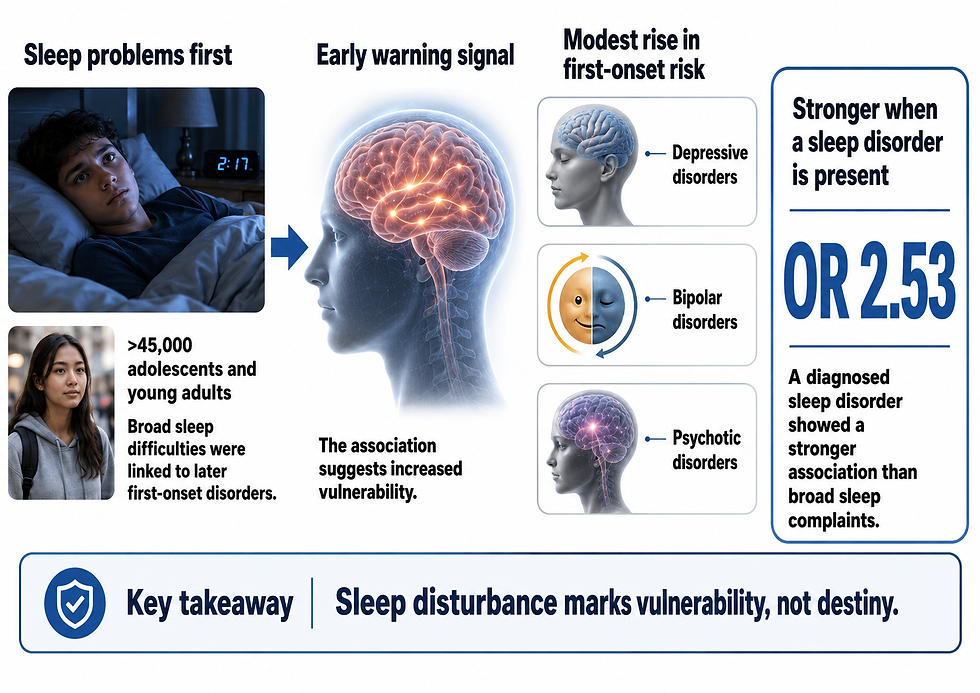
Bipolar disorder shows the clearest pattern: the prodrome before an initial mood episode averaged 27.1 months, while the subthreshold period before a recurrence averaged 1.0 month, a narrow window that makes changes in sleep and activity especially important after diagnosis (Van Meter et al., 2016).
Sleep loss can also act as a trigger, though not for everyone. Among 3,140 people with bipolar disorder, sleep-loss-triggered high mood was more common in women and in bipolar I disorder.
A circadian rhythm is the roughly 24-hour timing system that organizes sleep and wakefulness, so shift work, overnight caregiving, and time-zone travel can disturb it in vulnerable patients (Lewis et al., 2017).
One distinction changes the urgency of a visit. Decreased need for sleep means sleeping substantially less without fatigue or a wish for more sleep, unlike insomnia, which leaves the patient tired; it can mark emerging mania and should trigger prompt assessment of mood, energy, speech, judgment, and risk (American Psychiatric Association, 2022).
Childbirth offers a high-stakes test. In a prospective study of 76 women with bipolar I or schizoaffective-bipolar disorder, losing at least one full night of sleep around labor was associated with roughly fivefold higher odds of postpartum psychosis. The estimate was imprecise, but it supports a concrete plan: protect nighttime sleep, recruit caregiving support, and arrange rapid review when sleep vanishes (Perry et al., 2024).
Trials move the argument from prediction to prevention. Cognitive behavioral therapy for insomnia (CBT-I) is a structured treatment combining sleep scheduling, stimulus control, and cognitive strategies, not mere sleep hygiene.
In adults 60 or older with insomnia and no current depression, it cut incident or recurrent major depression from 25.9% to 12.2%, and in a 2025 trial of 708 people aged 15 to 25 with insomnia and subclinical symptoms, app-based CBT-I reduced 12-month depression from 18% to 10% (Chen et al., 2025; Irwin et al., 2022).
The first-episode assessment should reconstruct sleep before the behavior changed, mapping usual bedtime, wake time, duration, and variability against stress, medications, caffeine, alcohol, cannabis, and shift work; a sleep diary reduces recall error.
Do not assume every complaint is psychiatric insomnia, since snoring, witnessed pauses, or marked daytime sleepiness suggest obstructive sleep apnea (OSA), for which polysomnography is the standard study when suspected (Kapur et al., 2017; Schutte-Rodin et al., 2008).
The American Academy of Sleep Medicine recommends multicomponent CBT-I over sleep hygiene alone, and meta-analyses show that improving sleep also improves mental-health outcomes (Edinger et al., 2021; Hertenstein et al., 2022; A. J. Scott et al., 2021).
Episode-prevention evidence stays uneven, but the practical intervention is a sleep-protection plan: document the stable sleep window, identify the earliest pre-episode change, treat any diagnosed sleep disorder, adapt sleep-restriction to avoid provoking loss in bipolar disorder, and arrange rapid contact when the pattern returns (Furukawa et al., 2025; Harvey et al., 2015; Lewis et al., 2017).
“The clinically useful question is not whether sleep caused the episode by itself. It is whether the sleep change is a trigger, a prodrome, a consequence, a mimic, or some combination, and whether restoring sleep changes the trajectory.”
Treatment Is Larger Than the Prescription Pad
Cognitive behavioral therapy (CBT) teaches patients to test unhelpful predictions, change reinforcing behavior, and build skills that alter mood over time. Comparative reviews find no clear average difference between second-generation antidepressants and CBT for many adults in initial outpatient treatment, though the certainty of direct evidence is limited, and combining psychotherapy with medication often produces the best average acute outcomes (Amick et al., 2015; Cuijpers et al., 2020).
Acceptance and commitment therapy (ACT) uses acceptance, present-moment awareness, and values-guided action to reduce the behavioral dominance of distressing thoughts. Meta-analysis supports it for depressive symptoms against inactive and some usual-care controls, but evidence that it equals antidepressant medication is too limited for that stronger claim (Bai et al., 2020).
Neurofeedback gives patients real-time information about brain or physiological activity so they can learn self-regulation. Depression trials report promising changes, but samples are small, protocols vary, blinding is difficult, and publication bias cannot be excluded, so it is an emerging adjunct rather than a proven equal to antidepressants (Trambaiolli et al., 2021).

Repetitive transcranial magnetic stimulation (rTMS) delivers focused magnetic pulses through the scalp to modulate cortical networks. It is a neuromodulation treatment, not a behavioral one, and sham-controlled trials and network meta-analysis support several protocols for major depression, especially after medication nonresponse (George et al., 2010; Mutz et al., 2019).

Claims that one modality is at least as effective as another require a defined population, outcome, and time point, because average acute reduction does not predict durability, relapse prevention, adverse effects, cost, or access.
Selection should follow severity, prior response, preference, comorbidity, and risk: structured psychotherapy can lead for mild to moderate outpatient depression, while medication and somatic treatment become more urgent in severe, psychotic, suicidal, or recurrent illness, with measurement-based follow-up deciding whether the choice works (Amick et al., 2015; Cuijpers et al., 2020; Mutz et al., 2019).
“The revolutionary move is not to demote medication. It is to stop treating the prescription as the whole treatment plan.”
Ketamine Compresses the Antidepressant Clock
Treatment-resistant depression (TRD) usually refers to major depression that has not improved adequately after at least two appropriate antidepressant trials. Ketamine, a dissociative anesthetic, produced rapid antidepressant effects in early controlled studies of TRD, often within hours or a day, a time course sharply different from conventional monoaminergic antidepressants (Zarate et al., 2006).
Ketamine blocks the N-methyl-D-aspartate (NMDA) receptor in the glutamate system, but simple blockade does not fully explain its action. Current models emphasize a cascade of altered inhibitory control, a transient glutamate surge, AMPA-receptor signaling, synaptic protein synthesis, and rapid plasticity, and the mechanism remains active research rather than a settled pathway (Shinohara et al., 2021; Zanos & Gould, 2018).

Intranasal esketamine is approved for adults with TRD, and with an oral antidepressant for depressive symptoms in major depression with acute suicidal ideation or behavior, though the label states prevention of suicide has not been demonstrated. Sedation, dissociation, respiratory depression, blood-pressure elevation, and abuse risk require administration in a certified setting with at least two hours of observation (U.S. Food and Drug Administration, 2025b).
Rapid response is not universal remission, since some patients do not respond, benefits can fade, and maintenance raises cost and safety questions, though relapse-prevention trials support continued intermittent esketamine for selected responders when benefit keeps exceeding burden (Daly et al., 2019; Popova et al., 2019).
A fast drop in a depression score should also not be mistaken for proven suicide prevention, so patients in crisis still need direct safety assessment, means-safety planning, and a treatment setting that outlasts the dosing visit. Before treatment, verify the TRD history, review substance-use and cardiovascular risk, and set realistic goals; during treatment, measure symptoms, dissociation, sedation, and blood pressure rather than the drama of a rapid shift (U.S. Food and Drug Administration, 2025b).
“Ketamine's deepest challenge to the old model is temporal. A drug can change depressive symptoms before slow monoamine adaptations should have had time to explain the change.”
Alcohol's Health Halo Is Fading
Alcoholic beverages are an established human carcinogen, not merely a likely one. The International Agency for Research on Cancer classifies them as Group 1, with sufficient evidence of carcinogenicity in humans, and the U.S. Surgeon General concluded that alcohol causally increases risk for at least seven cancers: breast, colorectum, esophagus, liver, oral cavity, pharynx, and larynx (International Agency for Research on Cancer, 2024; Office of the Surgeon General, 2025).

The older claim that light drinking protects the heart relied on observational J-shaped curves. Confounding can create that appearance when abstainer groups include former heavy drinkers or the ill, and when moderate drinkers differ in income, diet, exercise, and healthcare access; analyses designed to reduce those biases have weakened the case for a net mortality benefit (Millwood et al., 2019; Zhao et al., 2023).
This does not mean every sip carries the same absolute risk, which still depends on dose, age, sex, genetics, and smoking. It does mean clinicians should stop presenting alcohol as a preventive intervention: risk can begin below levels many patients consider heavy, so people who do not drink should not start for health, and those who drink deserve nonjudgmental information about dose and cancer risk, plus screening for hazardous use and treatment for alcohol use disorder when indicated (Office of the Surgeon General, 2025; World Health Organization, 2024).
“Clinicians should not prescribe a carcinogenic intoxicant as a cardioprotective lifestyle habit. The safer message is simpler: people who do not drink should not start for health.”
Vaping Is Harm Reduction Only Under Strict Conditions
An electronic nicotine delivery system (ENDS) heats a liquid to create an inhaled aerosol, usually containing nicotine. The cessation evidence is no longer evenly mixed: a 2025 Cochrane living review of 90 studies found high-certainty evidence that nicotine e-cigarettes increased quit rates over nicotine replacement therapy (NRT), with a relative risk of 1.59 and about four extra quitters per 100 people treated (Lindson et al., 2025).
That benefit applies to adults trying to stop combustible cigarettes. It does not make vaping safe or justify use by adolescents, pregnant patients, nonsmokers, or people who have already quit, and the FDA states that authorized e-cigarettes are not FDA approved, that no tobacco product is safe, and that complete switching matters for risk reduction (U.S. Food and Drug Administration, 2026a, 2026b).
Dual use, meaning continued smoking while also vaping, can preserve much of the toxic exposure from combustion, and FDA guidance warns that long periods of it may add harms. The meaningful outcome is complete cigarette substitution followed, when feasible, by eventual nicotine abstinence (U.S. Food and Drug Administration, 2026b).
A practical plan includes a cigarette quit date, counseling, a product from the regulated legal market, and follow-up that tracks both cigarettes and vaping. FDA-approved varenicline, bupropion, and NRT remain first-line, and for an adult who cannot quit with those and chooses vaping, the goal is complete substitution rather than indefinite dual use (Lindson et al., 2025; U.S. Food and Drug Administration, 2026b).

“Vaping can reduce harm for an adult smoker only when it replaces combustible cigarettes. Adding it to smoking is not the same intervention.”
Cannabis Is Neither Panacea nor Harmless
Cannabis contains many compounds, but tetrahydrocannabinol (THC) produces most of the intoxication and cannabidiol (CBD) has different effects. The FDA has not approved the cannabis plant to treat any disease; it has approved a purified CBD product for specific seizure disorders and a few synthetic cannabinoid drugs for narrow indications, which shows why evidence must be product- and indication-specific (U.S. Food and Drug Administration, 2023).
For chronic pain, a 2025 living review found some oral or sublingual cannabinoids produced small short-term improvements with little or no gain in physical function, while dizziness, sedation, and nausea increased. Medical cannabis therefore names a heterogeneous marketplace, not one standardized treatment (Chou et al., 2025).
Cannabis exposure is associated with psychosis, a syndrome of impaired reality testing that can include hallucinations or delusions. The association is dose-dependent, with daily or high-potency use carrying greater risk and earlier adolescent exposure appearing especially concerning.
Recent studies link high-potency use in late adolescence to about twice the odds of new psychotic experiences and show a strong age-dependent tie to diagnosed psychotic disorder, though observational designs cannot prove cannabis alone causes every case (Di Forti et al., 2019; Hines et al., 2024; Marconi et al., 2016; McDonald et al., 2024).

Products sold under one label can differ sharply in THC, CBD, route, dose, and contaminants, so evidence from a purified cannabinoid cannot transfer to smoked flower or concentrates.
Heavy long-term use can also cause cannabinoid hyperemesis syndrome (CHS), recurrent nausea, abdominal pain, and vomiting that resolves with sustained cessation; clinicians should ask about age at first use, frequency, potency, psychosis history, pregnancy, and driving, aiming for precise risk communication rather than endorsement or moral panic (Chou et al., 2025; Sorensen et al., 2017; U.S. Food and Drug Administration, 2023).
“The clinical question is not whether cannabis is good or bad. It is which cannabinoid, at what dose, for which indication, delivered how, to which patient, and at what developmental stage.”
Conclusion: What These Revolutions Have in Common
These ten ideas overturn different assumptions but point the same way. Psychiatric symptoms can arise from brain disease, systemic illness, substance exposure, learned behavior, stress physiology, sleep and circadian disruption, and social conditions, often in combination, and no single label or receptor theory can carry that complexity (Mandal et al., 2022; Pollak et al., 2020; J. Scott et al., 2021).
The new standard is calibrated confidence: use EEG and laboratory testing when red flags justify them, treat diagnosed sleep disorders and sustained changes from a patient's baseline as measurable variables, and use medications with evidence for the target syndrome rather than the broad label (Galderisi et al., 2021; Gleeson et al., 2024; Graus et al., 2016).
The same discipline applies to public health: xylazine and medetomidine need local surveillance, vaping qualifies as harm reduction only with complete cigarette substitution, cannabis risk depends on age and potency, and alcohol needs direct cancer counseling rather than nostalgia about a protective daily drink (Centers for Disease Control and Prevention, 2026; Lindson et al., 2025; Office of the Surgeon General, 2025).
For clinicians the framework is simple to state and demanding to practice: define the target, reconstruct the timeline, protect sleep, test competing explanations, choose the least burdensome effective intervention, measure change, and revise the model when the patient surprises you. That is not skepticism about psychopharmacology; it is psychopharmacology becoming more scientific.
“The durable revolution is epistemic humility with clinical consequences. Good care becomes possible when a diagnosis can be reopened, a mechanism can be revised, and a treatment can be replaced when the outcome says it should be.”
Five Key Takeaways
1. Abrupt onset, neurological red flags, or repeated treatment failure should trigger targeted medical and neurological reassessment. EEG and specialty testing earn their place when a specific hypothesis justifies them, not as universal psychiatric screens.
2. The overdose emergency is now a fentanyl-plus-adulterant crisis. Give naloxone, support airway and circulation, and lean on local toxicology intelligence, because xylazine and medetomidine vary by place and time.
3. Conventional antipsychotics have limited evidence for primary negative symptoms. Cariprazine has direct trial support, while Cobenfy is an important non-dopamine advance whose negative-symptom efficacy remains unproven.
4. Depression is not one neurotransmitter deficit, and sleep is not a mere secondary symptom. Establish a sleep baseline, treat diagnosed sleep disorders, use sustained sleep change as a personalized warning signal, and match psychotherapy, medication, rTMS, or ketamine to severity and measured response.
5. Alcohol, vaping, and cannabis need precise risk communication. Alcohol is a known carcinogen, vaping helps only when it replaces smoking in adult smokers, and cannabis benefits and psychosis risks depend on product, dose, age, frequency, and vulnerability.

Glossary
acceptance and commitment therapy (ACT): a psychotherapy that uses acceptance, mindfulness, values clarification, and committed action to increase psychological flexibility.
autoimmune encephalitis: brain inflammation caused by immune mechanisms, often involving antibodies and sometimes presenting with psychiatric, cognitive, seizure, movement, or autonomic symptoms.
brain-derived neurotrophic factor (BDNF): a protein involved in neuronal survival, synaptic function, and plasticity; peripheral concentrations differ on average between depressed and nondepressed groups but are not diagnostic.
cannabidiol (CBD): a cannabis-derived cannabinoid with limited intoxicating effects; a purified formulation is approved for specific seizure disorders.
cannabinoid hyperemesis syndrome (CHS): recurrent nausea, abdominal pain, and vomiting associated with prolonged heavy cannabis use and typically improved by sustained cessation.
carcinogen: an agent capable of causing cancer; alcoholic beverages are classified as carcinogenic to humans.
circadian rhythm: an approximately 24-hour biological timing process that organizes sleep, wakefulness, hormone release, and related behavior across the day.
cognitive behavioral therapy (CBT): a structured psychotherapy that modifies maladaptive thoughts and behaviors through collaborative testing, skills practice, and behavioral change.
cognitive behavioral therapy for insomnia (CBT-I): a structured, multicomponent treatment using sleep scheduling, stimulus control, cognitive strategies, and related behavioral methods to reduce chronic insomnia.
confounding: distortion of an observed association by a third factor related to both the exposure and the outcome.
cortisol: a glucocorticoid hormone produced through HPA-axis activation that helps coordinate stress and metabolic responses.
decreased need for sleep: sleeping substantially less than usual without fatigue or a desire for more sleep, a clinically important manic symptom.
differential diagnosis: the systematic comparison of plausible causes for a patient’s presentation before settling on a final diagnosis.
dissociative anesthetic: an anesthetic that can produce analgesia, altered perception, and a sense of separation from self or environment; ketamine is the principal clinical example in this post.
dopamine D2 receptor: a dopamine receptor that is blocked or partially activated by many antipsychotic drugs and is central to their effects and adverse effects.
dual use: concurrent use of combustible cigarettes and e-cigarettes, which can preserve substantial toxic exposure from smoking.
electroencephalography (EEG): noninvasive recording of electrical activity from scalp electrodes, used clinically to evaluate seizures and diffuse cerebral dysfunction.
electronic nicotine delivery system (ENDS): a device that heats a liquid to generate an inhaled aerosol, usually containing nicotine.
fentanyl: a potent synthetic opioid used medically and also manufactured illicitly, where it is a major driver of overdose mortality.
glutamate: the major excitatory neurotransmitter in the central nervous system and a key target in current models of ketamine’s antidepressant action.
hypothalamic-pituitary-adrenal (HPA) axis: a hormonal stress-response system linking the hypothalamus, pituitary gland, and adrenal cortex.
medetomidine: a potent veterinary alpha-2 adrenergic sedative increasingly detected with illicit fentanyl and associated with prolonged sedation and severe withdrawal.
muscarinic receptor: a family of acetylcholine receptors that mediate central and peripheral cholinergic signaling; xanomeline acts at muscarinic receptors.
N-methyl-D-aspartate (NMDA) receptor: an ionotropic glutamate receptor involved in synaptic signaling and plasticity that is blocked by ketamine.
naloxone: an opioid-receptor antagonist that reverses opioid-induced respiratory depression but does not reverse xylazine or medetomidine.
negative symptoms: reductions in emotional expression, speech, motivation, pleasure, and social engagement associated with schizophrenia.
neurofeedback: training that presents real-time information about brain or physiological activity to support learned self-regulation.
neurogenesis: the generation of new neurons; evidence supports ongoing adult human hippocampal neurogenesis, although its clinical role remains under study.
neuroplasticity: the capacity of neural systems to change their structure, connectivity, or function in response to experience, injury, or treatment.
nicotine replacement therapy (NRT): medicinal nicotine delivered by products such as patches, gum, lozenges, inhalers, or nasal spray to reduce withdrawal during smoking cessation.
obstructive sleep apnea (OSA): repeated upper-airway narrowing or collapse during sleep that causes breathing interruptions, arousals, and sometimes oxygen desaturation.
partial agonist: a ligand that activates a receptor but produces less maximal effect than a full agonist at that receptor.
polysomnography: a monitored sleep study that records physiological signals used to diagnose sleep disorders such as obstructive sleep apnea.
positive symptoms: added experiences or behaviors in schizophrenia, including hallucinations, delusions, and disorganized thought or speech.
postpartum psychosis: an acute psychiatric episode after childbirth that can include mania, psychosis, severe mood disturbance, and rapid functional deterioration.
primary negative symptoms: negative symptoms considered intrinsic to schizophrenia rather than produced by depression, medication effects, active psychosis, substances, or environment.
prodrome: a period of early, often subthreshold changes that precedes the full onset or recurrence of an episode.
psychopharmacology: the study and clinical use of drugs that affect mood, cognition, perception, behavior, and other functions of the nervous system.
psychosis: a syndrome involving impaired reality testing, often expressed through hallucinations, delusions, or severe thought disorganization.
repetitive transcranial magnetic stimulation (rTMS): noninvasive neuromodulation that applies repeated magnetic pulses to targeted cortical regions.
secondary negative symptoms: negative-appearing symptoms caused or amplified by factors such as depression, sedation, parkinsonism, active psychosis, substance use, or social deprivation.
sleep diary: a daily record of sleep timing, awakenings, naps, and daytime effects used to characterize patterns over time.
sleep disorder: a diagnosable disturbance in sleep timing, duration, quality, or physiology that causes clinically significant distress or impairment.
sleep disturbance: a clinically important change in sleep duration, continuity, timing, or perceived refreshment that may or may not meet criteria for a sleep disorder.
tetrahydrocannabinol (THC): the principal intoxicating cannabinoid in cannabis and a contributor to dose- and potency-related psychosis risk.
toxicology: the study and clinical evaluation of harmful effects produced by drugs, chemicals, and other exposures.
toxidrome: a characteristic cluster of signs and symptoms that suggests a class of toxic exposure and guides emergency treatment.
treatment resistance: inadequate improvement despite treatment trials that were appropriate in selection, dose, duration, adherence, and delivery.
treatment-resistant depression (TRD): major depression that has not improved adequately after at least two appropriate antidepressant treatment trials.
xylazine: a veterinary alpha-2 adrenergic sedative found in some illicit fentanyl supplies and associated with prolonged sedation and serious skin injury.
References
.
American Psychiatric Association. (2022). Diagnostic and statistical manual of mental disorders (5th ed., text rev.). https://doi.org/10.1176/appi.books.9780890425787
Amick, H. R., Gartlehner, G., Gaynes, B. N., Forneris, C., Asher, G. N., Morgan, L. C., Coker-Schwimmer, E., Boland, E., Lux, L. J., Gaylord, S., Bann, C., Pierl, C. B., & Lohr, K. N. (2015). Comparative benefits and harms of second generation antidepressants and cognitive behavioral therapies in initial treatment of major depressive disorder: Systematic review and meta-analysis. BMJ, 351, h6019. https://doi.org/10.1136/bmj.h6019
Bai, Z., Luo, S., Zhang, L., Wu, S., & Chi, I. (2020). Acceptance and commitment therapy (ACT) to reduce depression: A systematic review and meta-analysis. Journal of Affective Disorders, 260, 728-737. https://doi.org/10.1016/j.jad.2019.09.040
Centers for Disease Control and Prevention. (2026, April 2). Medetomidine in the U.S. illegal fentanyl supply increasing risk for overdose and severe withdrawal syndrome (Health Alert Network Advisory No. 527). https://www.cdc.gov/han/php/notices/han00527.html
Chen, S.-J., Que, J.-Y., Chan, N. Y., Shi, L., Li, S. X., Chan, J. W. Y., Huang, W., Chen, C. X., Tsang, C. C., Ho, Y. L., Morin, C. M., Zhang, J.-H., Lu, L., & Wing, Y. K. (2025). Effectiveness of app-based cognitive behavioral therapy for insomnia on preventing major depressive disorder in youth with insomnia and subclinical depression: A randomized clinical trial. PLOS Medicine, 22(1), e1004510. https://doi.org/10.1371/journal.pmed.1004510
Chou, R., Ahmed, A. Y., Dana, T., Blazina, I., Selph, S., Fu, R., & Bougatsos, C. (2025). Living systematic review on cannabis and other plant-based treatments for chronic pain: 2025 update (Comparative Effectiveness Review No. 250; AHRQ Publication No. 25-EHC036). Agency for Healthcare Research and Quality. https://doi.org/10.23970/AHRQEPCCER250UPDATE2025
Cuijpers, P., Noma, H., Karyotaki, E., Vinkers, C. H., Cipriani, A., & Furukawa, T. A. (2020). A network meta-analysis of the effects of psychotherapies, pharmacotherapies and their combination in the treatment of adult depression. World Psychiatry, 19(1), 92-107. https://doi.org/10.1002/wps.20701
Dalmau, J., & Graus, F. (2018). Antibody-mediated encephalitis. New England Journal of Medicine, 378(9), 840-851. https://doi.org/10.1056/NEJMra1708712
Daly, E. J., Trivedi, M. H., Janik, A., Li, H., Zhang, Y., Li, X., Lane, R., Lim, P., Duca, A. R., Hough, D., Thase, M. E., Zajecka, J., Winokur, A., Divacka, I., Fagiolini, A.,
Cubala, W. J., Bitter, I., Blier, P., Shelton, R. C., ... Singh, J. B. (2019). Efficacy of esketamine nasal spray plus oral antidepressant treatment for relapse prevention in patients with treatment-resistant depression: A randomized clinical trial. JAMA Psychiatry, 76(9), 893-903. https://doi.org/10.1001/jamapsychiatry.2019.1189
Di Forti, M., Quattrone, D., Freeman, T. P., Tripoli, G., Gayer-Anderson, C., Quigley, H., Rodriguez, V., Jongsma, H. E., Ferraro, L., La Cascia, C., La Barbera, D., Tarricone, I., Berardi, D., Szöke, A., Arango, C., Tortelli, A., Velthorst, E., Bernardo, M., Del-Ben, C. M., ... EU-GEI WP2 Group. (2019). The contribution of cannabis use to variation in the incidence of psychotic disorder across Europe: The EU-GEI multicentre case-control study. The Lancet Psychiatry, 6(5), 427-436. https://doi.org/10.1016/S2215-0366(19)30048-3
Disouky, A., Sanborn, M. A., Sabitha, K. R., Mostafa, M. M., Ayala, I. A., Bennett, D. A., Lu, Y., Zhou, Y., Keene, C. D., Weintraub, S., Gefen, T., Mesulam, M.-M., Geula, C., Maienschein-Cline, M., Rehman, J., & Lazarov, O. (2026). Human hippocampal neurogenesis in adulthood, ageing and Alzheimer’s disease. Nature, 652, 1264-1273. https://doi.org/10.1038/s41586-026-10169-4
Edinger, J. D., Arnedt, J. T., Bertisch, S. M., Carney, C. E., Harrington, J. J., Lichstein, K. L., Sateia, M. J., Troxel, W. M., Zhou, E. S., Kazmi, U., Heald, J. L., & Martin, J. L. (2021). Behavioral and psychological treatments for chronic insomnia disorder in adults: An American Academy of Sleep Medicine clinical practice guideline. Journal of Clinical Sleep Medicine, 17(2), 255-262. https://doi.org/10.5664/jcsm.8986
Furukawa, Y., Salahuddin, N. H., Mao, J., Bighelli, I., & Leucht, S. (2025). Cognitive behavioral therapy for insomnia in people with schizophrenia: A systematic review and meta-analysis. Journal of Psychiatric Research, 191, 535-541. https://doi.org/10.1016/j.jpsychires.2025.09.083
Galderisi, S., Kaiser, S., Bitter, I., Nordentoft, M., Mucci, A., Sabé, M., Giordano, G. M., Nielsen, M. Ø., Glenthøj, L. B., Pezzella, P., Falkai, P., Dollfus, S., & EPA Guidance Working Group. (2021). EPA guidance on treatment of negative symptoms in schizophrenia. European Psychiatry, 64(1), e21. https://doi.org/10.1192/j.eurpsy.2021.13
George, M. S., Lisanby, S. H., Avery, D., McDonald, W. M., Durkalski, V., Pavlicova, M., Anderson, B., Nahas, Z., Bulow, P., Zarkowski, P., Holtzheimer, P. E., Schwartz, T., & Sackeim, H. A. (2010). Daily left prefrontal transcranial magnetic stimulation therapy for major depressive disorder: A sham-controlled randomized trial. Archives of General Psychiatry, 67(5), 507-516. https://doi.org/10.1001/archgenpsychiatry.2010.46
Gleeson, J. F., McGuckian, T. B., Fernandez, D. K., Fraser, M. I., Pepe, A., Taskis, R., Alvarez-Jimenez, M., Farhall, J. F., & Gumley, A. (2024). Systematic review of early warning signs of relapse and behavioural antecedents of symptom worsening in people living with schizophrenia spectrum disorders. Clinical Psychology Review, 107, 102357. https://doi.org/10.1016/j.cpr.2023.102357
Graus, F., Titulaer, M. J., Balu, R., Benseler, S., Bien, C. G., Cellucci, T., Cortese, I., Dale, R. C., Gelfand, J. M., Geschwind, M., Glaser, C. A., Honnorat, J., Höftberger, R., Iizuka, T., Irani, S. R., Lancaster, E., Leypoldt, F., Prüss, H., Rae-Grant, A., ... Dalmau, J. (2016). A clinical approach to diagnosis of autoimmune encephalitis. The Lancet Neurology, 15(4), 391-404. https://doi.org/10.1016/S1474-4422(15)00401-9
Harvey, A. G., Soehner, A. M., Kaplan, K. A., Hein, K., Lee, J., Kanady, J., Li, D., Rabe-Hesketh, S., Ketter, T. A., Neylan, T. C., & Buysse, D. J. (2015). Treating insomnia improves mood state, sleep, and functioning in bipolar disorder: A pilot randomized controlled trial. Journal of Consulting and Clinical Psychology, 83(3), 564-577. https://doi.org/10.1037/a0038655
Herken, J., & Prüss, H. (2017). Red flags: Clinical signs for identifying autoimmune encephalitis in psychiatric patients. Frontiers in Psychiatry, 8, 25. https://doi.org/10.3389/fpsyt.2017.00025
Hertenstein, E., Trinca, E., Wunderlin, M., Schneider, C. L., Züst, M. A., Fehér, K. D., Su, T., van Straten, A., Berger, T., Baglioni, C., Johann, A., Spiegelhalder, K., Riemann, D., Feige, B., & Nissen, C. (2022). Cognitive behavioral therapy for insomnia in patients with mental disorders and comorbid insomnia: A systematic review and meta-analysis. Sleep Medicine Reviews, 62, 101597. https://doi.org/10.1016/j.smrv.2022.101597
Hines, L. A., Heron, J., & Zammit, S. (2024). Incident psychotic experiences following self-reported use of high-potency cannabis: Results from a longitudinal cohort study. Addiction, 119(9), 1629-1634. https://doi.org/10.1111/add.16517
International Agency for Research on Cancer. (2024). Reduction or cessation of alcoholic beverage consumption (IARC Handbooks of Cancer Prevention, Vol. 20A). World Health Organization. https://www.iarc.who.int/faq/iarc-handbooks-of-cancer-prevention-volume-20a-reduction-or-cessation-of-alcohol-consumption/
Irwin, M. R., Carrillo, C., Sadeghi, N., Bjurstrom, M. F., Breen, E. C., & Olmstead, R. (2022). Prevention of incident and recurrent major depression in older adults with insomnia: A randomized clinical trial. JAMA Psychiatry, 79(1), 33-41. https://doi.org/10.1001/jamapsychiatry.2021.3422
Jauhar, S., Arnone, D., Baldwin, D. S., Bloomfield, M., Browning, M., Cleare, A. J., Cowen, P. J., Creswell, C., Critchley, H., Dwyer, D., Enache, D., Goodwin, G. M., Harrison, P. J., Harmer, C. J., Holmes, E. A., Howes, O. D., Keedwell, P., Lewis, G., McAllister-Williams, R. H., ... Young, A. H. (2023). A leaky umbrella has little value: Evidence clearly indicates the serotonin system is implicated in depression. Molecular Psychiatry, 28(8), 3149-3152. https://doi.org/10.1038/s41380-023-02095-y
Kapur, V. K., Auckley, D. H., Chowdhuri, S., Kuhlmann, D. C., Mehra, R., Ramar, K., & Harrod, C. G. (2017). Clinical practice guideline for diagnostic testing for adult obstructive sleep apnea: An American Academy of Sleep Medicine clinical practice guideline. Journal of Clinical Sleep Medicine, 13(3), 479-504. https://doi.org/10.5664/jcsm.6506
Kariisa, M., O’Donnell, J., Kumar, S., Mattson, C. L., & Goldberger, B. A. (2023). Illicitly manufactured fentanyl-involved overdose deaths with detected xylazine: United States, January 2019-June 2022. Morbidity and Mortality Weekly Report, 72(26), 721-727. https://doi.org/10.15585/mmwr.mm7226a4
Kaul, I., Sawchak, S., Correll, C. U., Kakar, R., Breier, A., Zhu, H., Miller, A. C., Paul, S. M., & Brannan, S. K. (2024a). Efficacy and safety of the muscarinic receptor agonist KarXT (xanomeline-trospium) in schizophrenia (EMERGENT-2) in the USA: Results from a randomised, double-blind, placebo-controlled, flexible-dose phase 3 trial. The Lancet, 403(10422), 160-170. https://doi.org/10.1016/S0140-6736(23)02190-6
Kaul, I., Sawchak, S., Walling, D. P., Tamminga, C. A., Breier, A., Zhu, H., Miller, A. C., Paul, S. M., & Brannan, S. K. (2024b). Efficacy and safety of xanomeline-trospium chloride in schizophrenia: A randomized clinical trial. JAMA Psychiatry, 81(8), 749-756. https://doi.org/10.1001/jamapsychiatry.2024.0785
Kirschner, M., Aleman, A., & Kaiser, S. (2017). Secondary negative symptoms: A review of mechanisms, assessment and treatment. Schizophrenia Research, 186, 29-38. https://doi.org/10.1016/j.schres.2016.05.003
Krause, M., Zhu, Y., Huhn, M., Schneider-Thoma, J., Bighelli, I., Nikolakopoulou, A., & Leucht, S. (2018). Antipsychotic drugs for patients with schizophrenia and predominant or prominent negative symptoms: A systematic review and meta-analysis. European Archives of Psychiatry and Clinical Neuroscience, 268(7), 625-639. https://doi.org/10.1007/s00406-018-0869-3
Lewis, K. J. S., Gordon-Smith, K., Forty, L., Di Florio, A., Craddock, N., Jones, L., & Jones, I. (2017). Sleep loss as a trigger of mood episodes in bipolar disorder: Individual differences based on diagnostic subtype and gender. British Journal of Psychiatry, 211(3), 169-174. https://doi.org/10.1192/bjp.bp.117.202259
Lindson, N., Livingstone-Banks, J., Butler, A. R., McRobbie, H., Bullen, C., Hajek, P., Begh, R., Wu, A. D., & Hartmann-Boyce, J. (2025). Electronic cigarettes for smoking cessation. Cochrane Database of Systematic Reviews, 2025(11), CD010216. https://doi.org/10.1002/14651858.CD010216.pub10
Mandal, P., Guha Roy, R., Ingole, R., Samkaria, A., Gaur, S., & Goel, A. (2022). Schizophrenia, bipolar and major depressive disorders: Overview of clinical features, neurotransmitter alterations, pharmacological interventions, and impact of oxidative stress in the disease process. ACS Chemical Neuroscience, 13(18), 2622-2637. https://doi.org/10.1021/acschemneuro.2c00397
Marconi, A., Di Forti, M., Lewis, C. M., Murray, R. M., & Vassos, E. (2016). Meta-analysis of the association between the level of cannabis use and risk of psychosis. Schizophrenia Bulletin, 42(5), 1262-1269. https://doi.org/10.1093/schbul/sbw003
McDonald, A. J., Kurdyak, P., Rehm, J., Roerecke, M., & Bondy, S. J. (2024). Age-dependent association of cannabis use with risk of psychotic disorder. Psychological Medicine, 54(11), 2926-2936. https://doi.org/10.1017/S0033291724000990
Millwood, I. Y., Walters, R. G., Mei, X. W., Guo, Y., Yang, L., Bian, Z., Bennett, D. A., Chen, Y., Dong, C., Hu, R., Zhou, G., Yu, B., Jia, W., Parish, S., Clarke, R., Davey Smith, G., Collins, R., Holmes, M. V., Li, L., ... China Kadoorie Biobank Collaborative Group. (2019). Conventional and genetic evidence on alcohol and vascular disease aetiology: A prospective study of 500,000 men and women in China. The Lancet, 393(10183), 1831-1842. https://doi.org/10.1016/S0140-6736(18)31772-0
Molendijk, M. L., Spinhoven, P., Polak, M., Bus, B. A. A., Penninx, B. W. J. H., & Elzinga, B. M. (2014). Serum BDNF concentrations as peripheral manifestations of depression: Evidence from a systematic review and meta-analyses on 179 associations. Molecular Psychiatry, 19(7), 791-800. https://doi.org/10.1038/mp.2013.105
Moncrieff, J., Cooper, R. E., Stockmann, T., Amendola, S., Hengartner, M. P., & Horowitz, M. A. (2023). The serotonin theory of depression: A systematic umbrella review of the evidence. Molecular Psychiatry, 28(8), 3243-3256. https://doi.org/10.1038/s41380-022-01661-0
Mutz, J., Vipulananthan, V., Carter, B., Hurlemann, R., Fu, C. H. Y., & Young, A. H. (2019). Comparative efficacy and acceptability of non-surgical brain stimulation for the acute treatment of major depressive episodes in adults: Systematic review and network meta-analysis. BMJ, 364, l1079. https://doi.org/10.1136/bmj.l1079
Nham, A., Le, J. N., Thomas, S. A., Gressick, K., Ussery, E. N., Ko, J. Y., Gladden, R. M., Mikosz, C. A., Schier, J. G., Vivolo-Kantor, A., Fiorillo, M., McMaster, M., Nolasco Magana, D., Verklan-McInnes, L., Wahl, M., Wood, T., Adams, A., Krotulski, A., Trecki, J., ... Hua, M. (2025). Overdoses involving medetomidine mixed with opioids: Chicago, Illinois, May 2024. Morbidity and Mortality Weekly Report, 74(15), 258-265. https://doi.org/10.15585/mmwr.mm7415a1
Németh, G., Laszlovszky, I., Czobor, P., Szalai, E., Szatmári, B., Harsányi, J., Barabássy, Á., Debelle, M., Durgam, S., Bitter, I., Marder, S., & Fleischhacker, W. W. (2017). Cariprazine versus risperidone monotherapy for treatment of predominant negative symptoms in patients with schizophrenia: A randomised, double-blind, controlled trial. The Lancet, 389(10074), 1103-1113. https://doi.org/10.1016/S0140-6736(17)30060-0
Office of the Surgeon General. (2025). Alcohol and cancer risk: The U.S. Surgeon General’s advisory. U.S. Department of Health and Human Services. https://www.hhs.gov/sites/default/files/oash-alcohol-cancer-risk.pdf
Perry, A., Gordon-Smith, K., Lewis, K. J. S., Di Florio, A., Craddock, N., Jones, L., & Jones, I. (2024). Perinatal sleep disruption and postpartum psychosis in bipolar disorder: Findings from the UK BDRN Pregnancy Study. Journal of Affective Disorders, 346, 21-27. https://doi.org/10.1016/j.jad.2023.11.005
Pollak, T. A., Lennox, B. R., Müller, S., Benros, M. E., Prüss, H., Tebartz van Elst, L., Klein, H., Steiner, J., Frodl, T., Bogerts, B., Tian, L., Groc, L., Hasan, A., Baune, B. T., Endres, D., Haroon, E., Meyer, J. H., Stassen, H., Najjar, S., ... Bechter, K. (2020). Autoimmune psychosis: An international consensus on an approach to the diagnosis and management of psychosis of suspected autoimmune origin. The Lancet Psychiatry, 7(1), 93-108. https://doi.org/10.1016/S2215-0366(19)30290-1
Popova, V., Daly, E. J., Trivedi, M., Cooper, K., Lane, R., Lim, P., Mazzucco, C., Hough, D., Thase, M. E., Shelton, R. C., Molero, P., Vieta, E., Bajbouj, M., Manji, H., Drevets, W. C., & Singh, J. B. (2019). Efficacy and safety of flexibly dosed esketamine nasal spray combined with a newly initiated oral antidepressant in treatment-resistant depression: A randomized double-blind active-controlled study. American Journal of Psychiatry, 176(6), 428-438. https://doi.org/10.1176/appi.ajp.2019.19020172
Reeve, S., Sheaves, B., & Freeman, D. (2015). The role of sleep dysfunction in the occurrence of delusions and hallucinations: A systematic review. Clinical Psychology Review, 42, 96-115. https://doi.org/10.1016/j.cpr.2015.09.001
Schutte-Rodin, S., Broch, L., Buysse, D., Dorsey, C., & Sateia, M. (2008). Clinical guideline for the evaluation and management of chronic insomnia in adults. Journal of Clinical Sleep Medicine, 4(5), 487-504. https://doi.org/10.5664/jcsm.27286
Scott, A. J., Webb, T. L., Martyn-St James, M., Rowse, G., & Weich, S. (2021). Improving sleep quality leads to better mental health: A meta-analysis of randomised controlled trials. Sleep Medicine Reviews, 60, 101556. https://doi.org/10.1016/j.smrv.2021.101556
Scott, J., Kallestad, H., Vedaa, O., Sivertsen, B., & Etain, B. (2021). Sleep disturbances and first onset of major mental disorders in adolescence and early adulthood: A systematic review and meta-analysis. Sleep Medicine Reviews, 57, 101429. https://doi.org/10.1016/j.smrv.2021.101429
Shinohara, R., Aghajanian, G. K., & Abdallah, C. G. (2021). Neurobiology of the rapid-acting antidepressant effects of ketamine: Impact and opportunities. Biological Psychiatry, 90(2), 85-95. https://doi.org/10.1016/j.biopsych.2020.12.006
Sorensen, C. J., DeSanto, K., Borgelt, L., Phillips, K. T., & Monte, A. A. (2017). Cannabinoid hyperemesis syndrome: Diagnosis, pathophysiology, and treatment: A systematic review. Journal of Medical Toxicology, 13(1), 71-87. https://doi.org/10.1007/s13181-016-0595-z
Sorrells, S. F., Paredes, M. F., Cebrian-Silla, A., Sandoval, K., Qi, D., Kelley, K. W., James, D., Mayer, S., Chang, J., Auguste, K. I., Chang, E. F., Gutierrez, A. J., Kriegstein, A. R., Mathern, G. W., Oldham, M. C., Huang, E. J., Garcia-Verdugo, J. M., Yang, Z., & Alvarez-Buylla, A. (2018). Human hippocampal neurogenesis drops sharply in children to undetectable levels in adults. Nature, 555(7696), 377-381. https://doi.org/10.1038/nature25975
St. Louis, E. K., Frey, L. C., Britton, J. W., Hopp, J. L., Korb, P., Koubeissi, M. Z., Lievens, W. E., & Pestana-Knight, E. M. (2016). Electroencephalography (EEG): An introductory text and atlas of normal and abnormal findings in adults, children, and infants. American Epilepsy Society. https://www.ncbi.nlm.nih.gov/books/NBK390354/
Stetler, C., & Miller, G. E. (2011). Depression and hypothalamic-pituitary-adrenal activation: A quantitative summary of four decades of research. Psychosomatic Medicine, 73(2), 114-126. https://doi.org/10.1097/PSY.0b013e31820ad12b
Trambaiolli, L. R., Kohl, S. H., Linden, D. E. J., & Mehler, D. M. A. (2021). Neurofeedback training in major depressive disorder: A systematic review of clinical efficacy, study quality and reporting practices. Neuroscience & Biobehavioral Reviews, 125, 33-56. https://doi.org/10.1016/j.neubiorev.2021.02.015
U.S. Food and Drug Administration. (2023, February 24). FDA and cannabis: Research and drug approval process. https://www.fda.gov/news-events/public-health-focus/fda-and-cannabis-research-and-drug-approval-process
U.S. Food and Drug Administration. (2024a, September 26). FDA approves drug with new mechanism of action for treatment of schizophrenia. https://www.fda.gov/news-events/press-announcements/fda-approves-drug-new-mechanism-action-treatment-schizophrenia
U.S. Food and Drug Administration. (2025a, December 15). Untitled letter to Bristol Myers Squibb Company regarding Cobenfy promotional communications. https://www.fda.gov/media/190245/download
U.S. Food and Drug Administration. (2025b). Spravato (esketamine) nasal spray prescribing information. https://www.jnjlabels.com/package-insert/product-monograph/prescribing-information/SPRAVATO-pi.pdf
U.S. Food and Drug Administration. (2026a, May 5). E-cigarettes authorized by the FDA. https://www.fda.gov/tobacco-products/market-and-distribute-tobacco-product/e-cigarettes-vapes-and-other-electronic-nicotine-delivery-systems-ends-authorized-fda
U.S. Food and Drug Administration. (2026b, May 6). The relative risks of tobacco products. https://www.fda.gov/tobacco-products/health-effects-tobacco-use/relative-risks-tobacco-products
Van Meter, A. R., Burke, C., Youngstrom, E. A., Faedda, G. L., & Correll, C. U. (2016). The bipolar prodrome: Meta-analysis of symptom prevalence prior to initial or recurrent mood episodes. Journal of the American Academy of Child & Adolescent Psychiatry, 55(7), 543-555. https://doi.org/10.1016/j.jaac.2016.04.017
World Health Organization. (2024, June 28). Alcohol. https://www.who.int/news-room/fact-sheets/detail/alcohol
Zanos, P., & Gould, T. D. (2018). Mechanisms of ketamine action as an antidepressant. Molecular Psychiatry, 23(4), 801-811. https://doi.org/10.1038/mp.2017.255
Zarate, C. A., Jr., Singh, J. B., Carlson, P. J., Brutsche, N. E., Ameli, R., Luckenbaugh, D. A., Charney, D. S., & Manji, H. K. (2006). A randomized trial of an N-methyl-D-aspartate antagonist in treatment-resistant major depression. Archives of General Psychiatry, 63(8), 856-864. https://doi.org/10.1001/archpsyc.63.8.856
Zhao, J., Stockwell, T., Naimi, T., Churchill, S., Clay, J., & Sherk, A. (2023). Association between daily alcohol intake and risk of all-cause mortality: A systematic review and meta-analyses. JAMA Network Open, 6(3), e236185. https://doi.org/10.1001/jamanetworkopen.2023.6185
About the Author
Fred Shaffer earned his PhD in Psychology from Oklahoma State University. He earned BCIA certifications in Biofeedback and HRV Biofeedback. Fred is an Allen Fellow and Professor of Psychology at Truman State University, where he has taught for 50 years. He is a Biological Psychologist who consults and lectures in heart rate variability biofeedback, Physiological Psychology, and Psychopharmacology. Fred helped to edit Evidence-Based Practice in Biofeedback and Neurofeedback (3rd and 4th eds.) and helps to maintain BCIA's certification programs. He is a recipient of AAPB's Distinguished Scientist Award and BFE's Lifetime Impact Award.

Support Our Friends


One thing I appreciate in AI coverage is attention to alternatives worth considering, since the obvious option is not always the right fit.
Securing sensitive infrastructure against prompt injection and sandbox escapes is critical, and explore these guidelines for a thorough breakdown of multi-tiered defense layers.
The nanoclaw.net introductory guide is useful for anyone who wants to understand what this MIT-licensed assistant actually does before trying it. It covers the core components like container isolation and WhatsApp integration in a way that's easy to follow, even if you haven't used similar tools before.